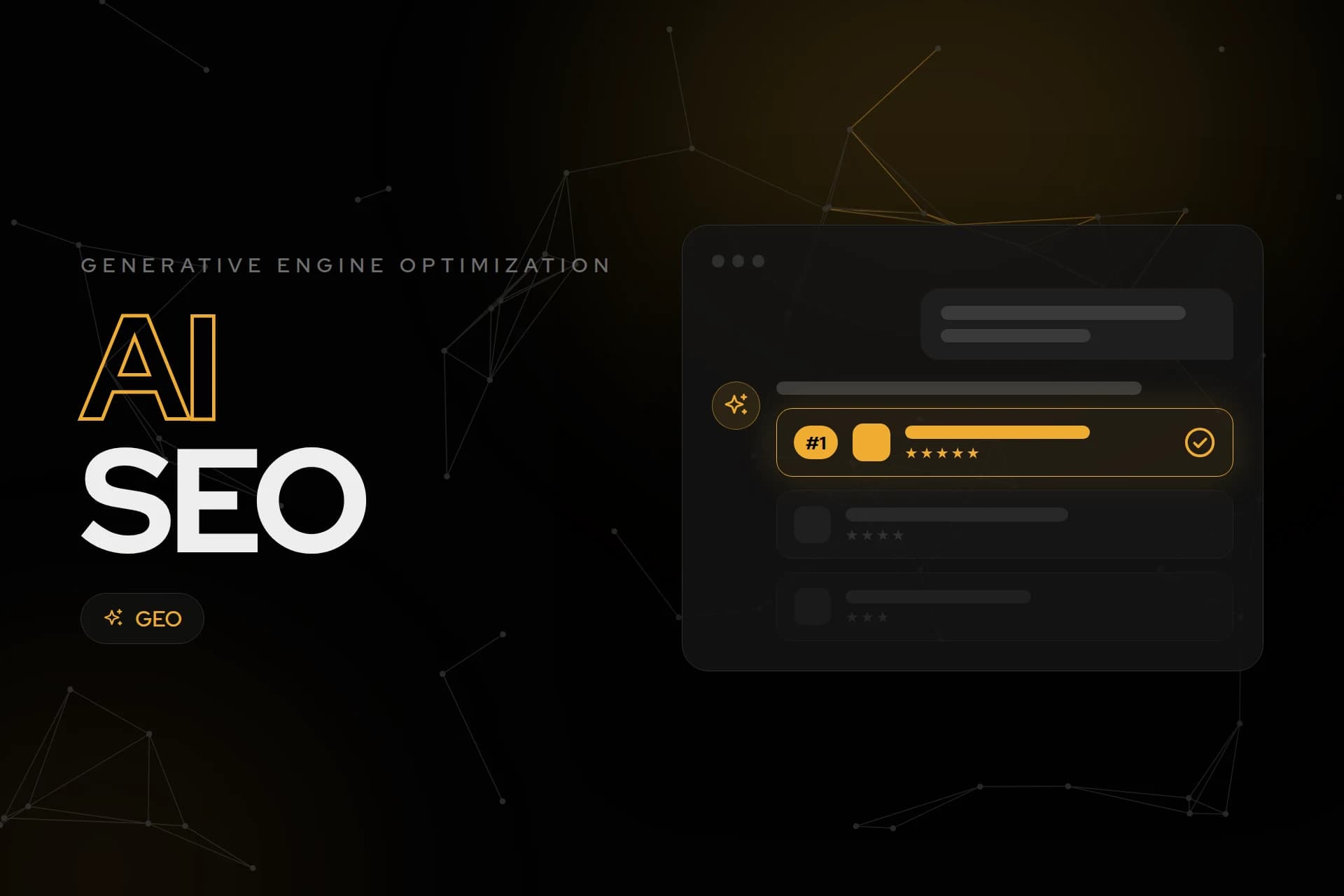
Imagine someone looking for an electrician in their city. In the past, they would open Google, scan the first five results, and call one. Today they increasingly open ChatGPT and type: “Recommend a reliable electrician near me.” They get one answer, with two or three names and a short explanation of why those. They do not look at a list of links or compare websites. They call one of those names.
If your business is not among those names, that client will never even see you. This is exactly where AI SEO comes in.
What Is AI SEO, or GEO
AI SEO, often called GEO (Generative Engine Optimization), is optimizing your website and online presence so that AI assistants understand, cite, and recommend you. By AI assistants we mean ChatGPT, Gemini, Perplexity, Microsoft Copilot, and the AI Overviews that appear at the top of Google search.
Classic SEO competes for a spot in the list of links. AI SEO competes for a spot in the answer itself. That is a big difference, because an AI answer has no second page of results. You are either in the answer or you are not.
Why This Matters Right Now
Habits are changing faster than most businesses notice. People use AI assistants for things they used to use a search engine for: comparing services, asking for a recommendation, finding out what something costs. Google itself has added AI answers to the top of search, so some users get their answer before they even see the organic results.
That does not mean classic SEO is dead. It means ranking high on Google is no longer enough. You also need to be the business AI recognizes as a relevant, trustworthy answer.
How AI Decides Who to Recommend
AI assistants do not pick at random. They rely on information they can find and verify. What matters most to them:
- Clear content on your website that directly answers clients' questions
- Consistent business information: the same name, address, services, and description everywhere online
- Reviews on your Google profile and other platforms
- Mentions on other sites: portals, directories, articles, and forums
- Structured data (schema) that explains to machines who you are and what you do
- Technical accessibility: a site AI crawlers can read quickly and without problems
The clearer and more consistent this information is, the more confident AI is in recommending you. If it is scattered, contradictory, or missing, AI will rather mention a competitor it knows more about.
How AI SEO Differs From Classic SEO
The foundation is the same: a fast, technically sound website with quality content. But AI SEO puts the emphasis on a few things that were secondary in classic SEO.
First, answers instead of keywords. AI is not looking for a page that repeats “electrician in my city” ten times, but for a page that clearly says what you do, for whom, where, roughly what it costs, and why you are a good choice. Second, reputation beyond your website. Mentions and reviews elsewhere carry more weight, because AI checks whether others confirm what you claim about yourself. Third, accurate information. An old address in one directory or the wrong services in another can confuse AI and push you out of the answer.
What You Can Do Today
You do not need a big strategy to take the first steps. These are things any business can check in an afternoon:
- Ask ChatGPT and Gemini to recommend a business for your service in your city and write down who they mention
- Ask AI what it knows about your business and check whether the information is correct
- Clean up your Google Business profile: accurate services, opening hours, photos, and regular reviews
- Check that your name, address, and phone number are the same on your website, social media, and directories
- Add a page with frequently asked questions and clear, concrete answers to your website
- Write on your homepage, in two sentences, what you do, for whom, and where
Mistakes That Cost You Recommendations
The most common mistake is a website that looks nice but says nothing concrete. Slogans like “quality and reliability come first” tell AI nothing. The second mistake is neglecting reviews, because a business with three reviews from a few years ago is far less convincing to AI than one with regular, recent ratings. The third is blocking AI crawlers, often by accident, through website or hosting settings. If AI cannot read your website, it cannot recommend you either.
How Quickly You See Results
Some changes show up quickly. Assistants that search the web live, such as Perplexity or ChatGPT with search, can pick up fixes within a few weeks. A stable presence in answers usually takes three to six months of consistent work on content, reviews, and mentions. It is also worth saying honestly: no one can guarantee that ChatGPT will recommend you, because answers depend on many factors. What can be done is to remove the reasons AI skips you and systematically increase the chances it mentions you.
Conclusion
AI SEO is not a replacement for classic SEO, it is its next step. Businesses that get their online presence in order now will be the ones AI recommends once this habit becomes the norm. If you want to find out what AI says about your business today, and for which questions it recommends competitors instead of you, we can run a free audit and show you concrete next steps.